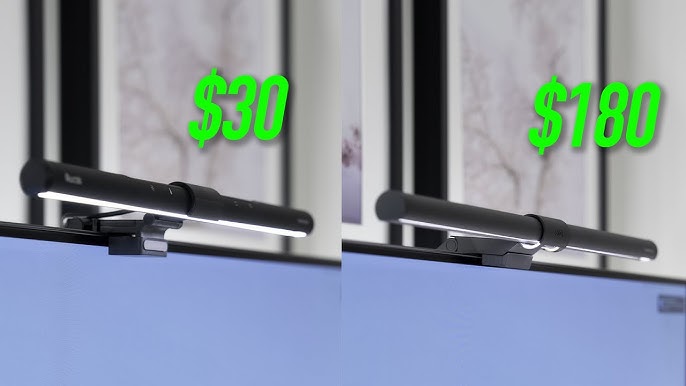
The Yeelight screen light bar delivers about 90% of the BenQ ScreenBar experience for one-third the price. Unless you specifically need auto-dimming or a wireless remote, save the $42.
Quick Specs
| Feature | Yeelight (~$18) | BenQ ScreenBar ($60) |
|---|---|---|
| Light source | Dual-color LED | Dual-color LED |
| Color temp range | 2700K–6500K | 2700K–6500K |
| CRI | Ra 95 | Ra 95 |
| Brightness | ~300 lux | ~320 lux |
| Auto-dimming | No | Yes |
| Remote control | No (touch + app) | No (touch only) |
| Power | USB-C, ~5W | USB-C/A, ~5W |
| Body material | Aluminium | Aluminium |
| Clamp type | Gravity | Gravity |
| Price | $18 | $60 |
Light Quality
I ran both bars on the same monitor for two weeks, switching nightly. Honest answer: the difference is marginal. Both produce even, asymmetric light that illuminates your desk without reflecting off your screen. Both cover 2700K to 6500K. Both hit Ra 95 CRI.
The BenQ throws slightly more even light at the desk edges. If you measure with a lux meter at the far corners, BenQ wins by about 10-15%. In daily use, sitting at a normal distance, I could not tell them apart without looking at the label.
One real difference: the BenQ’s optical design produces a slightly sharper cutoff at the screen boundary. The Yeelight occasionally catches the very top edge of my 27" panel at maximum brightness. Running it at 70-80% brightness eliminates this entirely.
Build and Controls
Both bars are aluminium. Both feel solid. The BenQ has tighter machining tolerances and a slightly nicer matte finish, the kind of thing you notice when holding them side by side and forget about once they’re mounted above your screen.
I actually prefer the Yeelight’s touch controls. Slide your finger along the bar for brightness, tap to switch modes. The BenQ has a similar touch strip but the zones feel smaller. Neither is bad. Neither is great. They’re light bars, not musical instruments.
The BenQ ScreenBar Plus ($90) adds a desktop dial controller, which is genuinely nice. But that’s a $90 comparison, not a $60 one.
The Auto-Dimming Question
This is BenQ’s strongest card. The ScreenBar has an ambient light sensor that adjusts brightness automatically based on room conditions. The Yeelight does not.
Here’s the thing. I set my Yeelight to 60% brightness, 4000K, and haven’t touched it in months. My office lighting doesn’t change dramatically throughout the day. If yours does – say you work near a window with shifting sunlight – the auto-dimming sensor has real value. If you work in a typical indoor setup with consistent overhead lighting, you’ll set it once and never think about it again.
Is auto-dimming worth $42? For most desk setups, no.
Mounting Compatibility
Both use gravity clamps. Both fit monitors with bezels up to about 30-35mm. The Yeelight clamp is slightly less forgiving on very thick bezels. My Dell U2722D (thin bezel) works perfectly with both. A colleague’s older HP with a chunky bezel fit the BenQ but not the Yeelight.
If your monitor was made after 2020, either will fit. If it’s older with thick bezels, measure before ordering.
Price and Value
The math is simple. The Yeelight costs $18. The BenQ costs $60. The quality gap is maybe 10-15%.
Is the BenQ 3x better? After six months with both, my answer is no. The BenQ is a better product. Marginally better light distribution, auto-dimming, tighter build. But the Yeelight nails the fundamentals – good asymmetric lighting, solid build, USB-C power – at a price that makes the comparison almost unfair.
If you’re buying one light bar for a home office, the Yeelight is the rational choice. If you’re outfitting a company office and expensing it, sure, get the BenQ.
Buy the Yeelight If
- Budget matters and you want solid desk lighting under $20
- Your room has consistent lighting (no auto-dimming needed)
- You use a modern thin-bezel monitor
- You’re fine reaching up to the bar for adjustments
Buy the BenQ If
- You work near a window and want auto-dimming
- Your company is paying
- You want the absolute best, even if the margin is small
- You plan to get the Plus model with the desktop dial ($90)
The Bottom Line
The Yeelight screen light bar is the best value in desk lighting. It does the job a $60 BenQ does, for $18, and does it well. The BenQ is the better product on paper – but “better” and “3x better” are different conversations.
Buy the Yeelight. Spend the $42 you saved on something that actually changes your setup. Read our full Yeelight review for the six-month daily use breakdown, or see where both bars land in our Best Screen Light Bars 2026 ranking. For more on Yeelight and other Chinese desk brands, check our Chinese Brands Desk Gear Guide.
-> Check Yeelight Screen Light Bar on Amazon -> Check BenQ ScreenBar on Amazon
Both products purchased with personal funds. No brand relationships.