
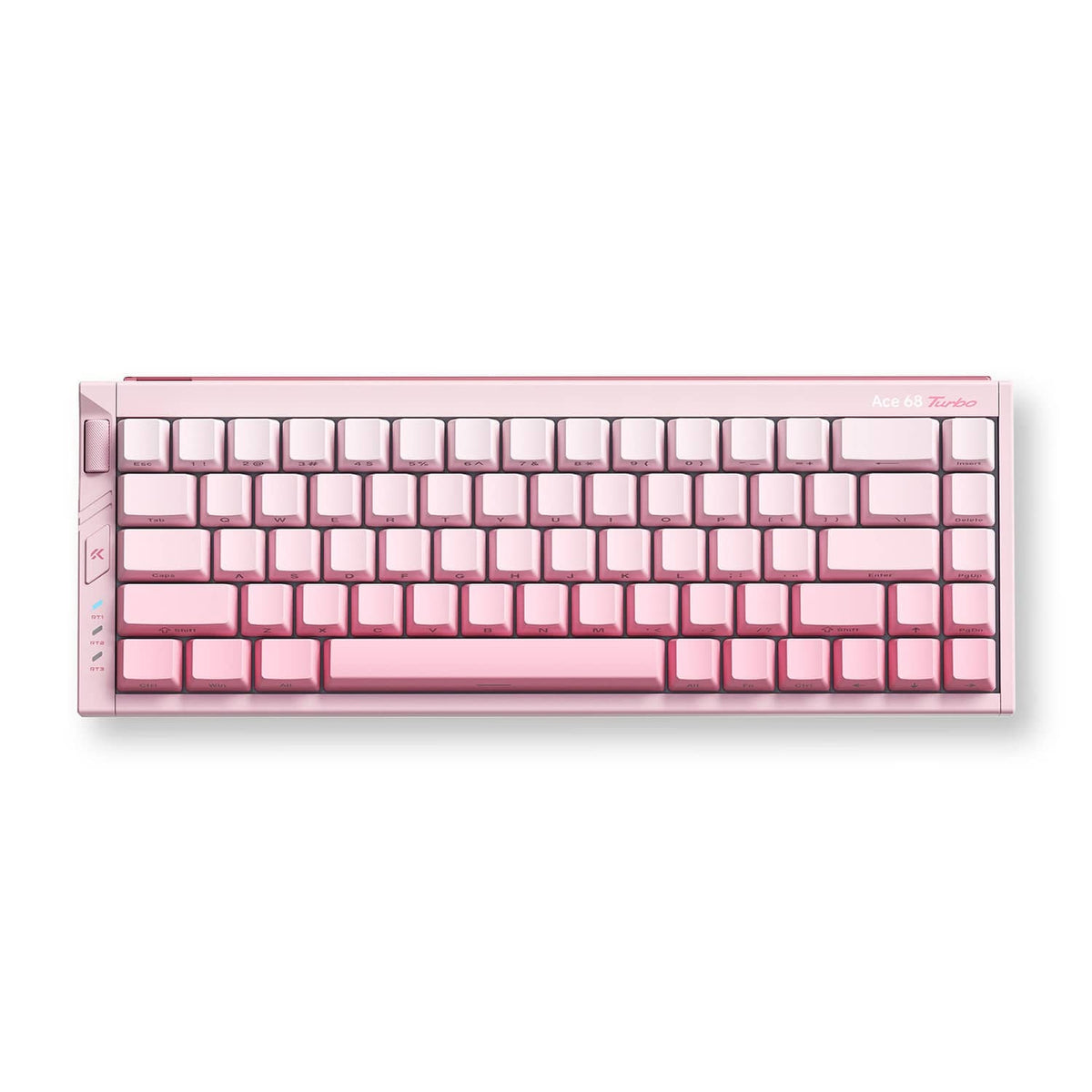
The MCHOSE Ace 68 Turbo is a legitimately good keyboard that happens to be packaged around a specification nobody asked for. At $139, you’re getting a full CNC aluminum body, Hall Effect switches with sub-millimeter rapid trigger, and five layers of sound dampening. The 16,000Hz polling rate is how MCHOSE got onto the press release circuit. The aluminum shell is why you’d actually want it.
China’s keyboard market has hit a phase of 内卷 (nèijuàn — the kind of relentless spec escalation where everyone races to claim “world’s first” and the customer benefits mostly in spec-sheet arguments). The Ace 68 Turbo is the current winner of that race. It launched October 2025 and immediately attracted coverage from PC Gamer and XSReviews. Most reviews said some version of the same thing: the 16K headline is theater, and the keyboard underneath it is actually quite good.
That’s accurate. Let me explain why.
What You’re Actually Paying For
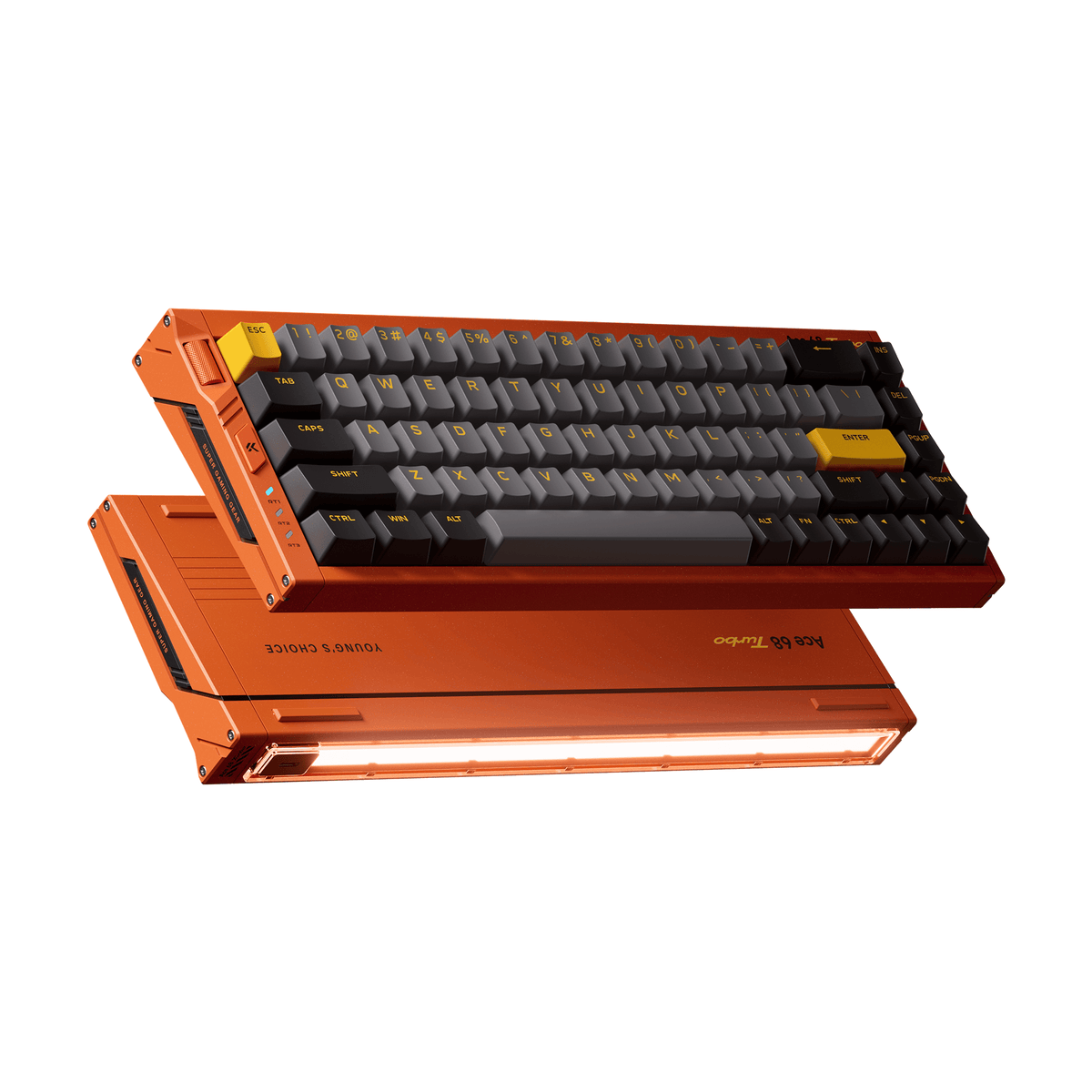
The chassis is 6063 CNC-machined aluminum, which means the entire enclosure — not just the top plate — is machined aluminum. At 1.3kg, it feels like an engineering component rather than a consumer product. You could use it as a paperweight for medium-sized documents, or (more practically) notice that it doesn’t shift when you’re punching keys during a CS2 clutch.
The 65% layout fits 68 keys, including dedicated arrow keys squeezed into the right side. The multi-function control knob sits at the top-right and handles volume, media, and (with software) custom assignments. A front-edge RGB light bar adds the obligatory gaming aesthetic without dominating the surface.
Five-layer HiFi cushioning — PORON foam, silicone pads, PCB dampening — produces a typing sound that sits in the “dense thock” category. For a keyboard marketed primarily at competitive gamers, the acoustic tuning is thoughtfully handled. Double-shot PBT keycaps with clean legends are included; no aftermarket upgrade needed immediately.
16K Polling Rate in Practice
The math is simple enough that I’ll walk through it, because I’d want someone to do that for me before I paid extra for it. At 8K polling, the keyboard reports to your PC every 0.125ms. At 16K, it’s every 0.0625ms. The improvement: 0.0625ms — 62.5 microseconds. A single frame at 144Hz monitors is 6.94ms. The 16K advantage over 8K is 0.9% of one frame at 144Hz, or 0.8% of a 128-tick CS2 server tick.
I tested this keyboard for three hours across CS2 and Valorant, head-to-head against a Wooting 60HE v2 at 8K polling. I noticed no difference in performance. Neither will you. Neither will your aim trainer graphs.
What the 16K polling does require: downloading the MCHOSE Hub driver, running a firmware update, and accepting terms that appear only in Chinese. (I clicked through. No follow-up from the Chinese government. Desk setup intact.) This is the only realistic path to unlocking the headline feature, and it’s clunky enough to frustrate users who aren’t comfortable navigating partially localized software.
Hall Effect Switches: The Part That Actually Matters
Hall Effect switches actuate magnetically with no physical contact between components. They don’t wear out the way traditional mechanical switches do — no friction, no spring fatigue over millions of keypresses. The Mount Tai GT switches in the 16K variant offer linear actuation at 1.5mm, 3.5mm total travel, pre-lubed from the factory.
Rapid Trigger is configurable down to 0.001mm resolution in MCHOSE Hub or via web interface. The MCHOSE Ace 68 V2 went to 0.01mm; the Turbo goes ten times finer. Whether the human finger can perceive 0.001mm resolution during gameplay is another question entirely, but the specification exists and the hardware supports it.
For typing, not gaming: the switches produce a satisfying, consistent actuation that held up across extended writing sessions. The aluminum chassis damps vibration in a way that makes sustained use more comfortable than the spec sheet would suggest. I wrote over 2,000 words on this keyboard before wanting to switch back to my usual board. That’s a real data point.
An external Rapid Trigger button on the case lets you cycle between three RT profiles without opening software. Small detail. Genuinely useful in practice.
Where the Turbo Loses Ground
The wired-only constraint is the most significant limitation. MCHOSE makes the Air HE variant for users who want wireless; the Turbo stays on USB-C only, presumably because sustaining 16K polling over 2.4GHz or Bluetooth isn’t currently feasible. If you move your keyboard between setups or use it with a laptop away from your desk, this is a hard stop.
The software gap between MCHOSE and Wooting is real. Wooting’s Wootility app is polished, well-documented, and fully English. MCHOSE Hub works, but the firmware update process isn’t intuitive, and some users report occasional connection drop-outs on certain system configurations. It’s not a dealbreaker, but it’s the area where paying $100 more for a Wooting buys you something tangible.
The 1.3kg weight is worth noting plainly: this keyboard is not going in a bag. It will stay on your desk. If that doesn’t describe your workflow, plan accordingly.
Who Should Buy the MCHOSE Ace 68 Turbo
Buy this keyboard if you want a full-aluminum Hall Effect 65% with a control knob, competitive rapid trigger performance, and solid PBT keycaps at a price where equivalent materials from Western brands start at $200-plus.
Don’t buy it specifically for 16K polling. The spec exists and the hardware supports it, but the gameplay benefit is measured in hundredths of a millisecond. The 真香 (zhēn xiāng — the Chinese internet shorthand for “I said I didn’t need this and now I have ordered a second one”) moment with the Ace 68 Turbo arrives when you pick up the chassis and feel 1.3kg of machined aluminum, not when you enable 16K mode.
Compared to the MCHOSE Ace 68 V2 at $80: the Turbo adds a substantially better chassis and switch options at a $59 premium. If build quality matters to you, the upgrade makes sense. If it doesn’t, save the $59.


