Most People Know Edifier Wrong
Most people know Edifier as “that $28 speaker brand on Amazon.” Maybe you’ve seen the G1500BAR on a Reddit battlestation post. Maybe a friend had a pair of R1280s in college. Solid budget pick, nothing special.
Here’s what that reputation misses. Edifier is a publicly traded company on the Shenzhen Stock Exchange (002351.SZ) with a market cap around $1.39 billion. They ship over 8 million units per year to 70+ countries. They employ about 3,000 people. And in December 2011, they bought 100% of STAX Ltd., the Japanese electrostatic headphone maker that audiophiles treat like a holy relic.
That’s a pretty big gap between brand perception and brand reality.
How Did Edifier Get Here?
Wendong Zhang founded Edifier (漫步者) in Beijing in 1996. His first product was a pair of all-wood, anti-magnetic PC speakers. This was the era when every computer speaker was a plastic disaster that buzzed if you put it too close to your CRT monitor. Zhang’s pitch was simple: build something that sounds decent and doesn’t fall apart.
It worked. Edifier grew through China’s PC boom of the early 2000s, becoming the default desktop speaker brand in internet cafes and home offices across the country. By 2007 they’d moved their manufacturing headquarters to Dongguan’s Songshan Lake Technology Park, a 100,000 square meter facility where they make essentially everything in-house.
The IPO came in 2010 on the Shenzhen Stock Exchange. Revenue has grown to approximately $389 million USD (2025 TTM). That puts them in a different weight class than most “budget speaker brands” you’ve heard of.
But the move that really changed the company’s trajectory? That happened a year after going public.
Why Does Edifier Own STAX?
In December 2011, Edifier acquired 100% of STAX Ltd., a Japanese company founded in 1938 that basically invented electrostatic headphones. If you’re not into headphones, here’s the short version: STAX makes $3,000-$5,000 headphone systems that audiophile forums argue about with religious intensity. They’re considered some of the best-sounding headphones ever made.
Edifier didn’t gut the company. They retained all STAX staff, kept production in Japan, and built a new factory in Saitama Prefecture. The STAX SR-009 and Lambda series continued without interruption.
What Edifier got was credibility and R&D talent. What came out of that combination, years later, was the STAX Spirit S3 and S5: wireless planar magnetic headphones in the $400-$500 range that bring STAX tuning expertise to Bluetooth products. The S3 won a What Hi-Fi? Award and a VGP Gold award in Japan.
(I still think about this acquisition sometimes. A Chinese budget speaker company buying a Japanese audiophile institution. In 2011, people probably laughed. Fifteen years later, the STAX Spirit line exists because of it. Funny how that works.)
What Edifier Desktop Speakers Should You Actually Buy?
Edifier’s product lineup is wide. Too wide, honestly. They sell everything from $28 soundbars to $700 planar tweeter flagships. Here’s the range that matters for desk setups, cheapest to most expensive.
R1280T / R1280DBs ($100-$160)
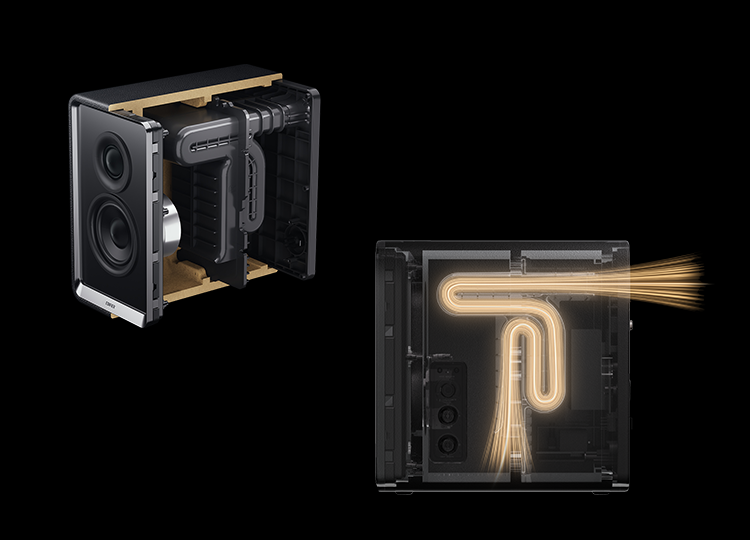
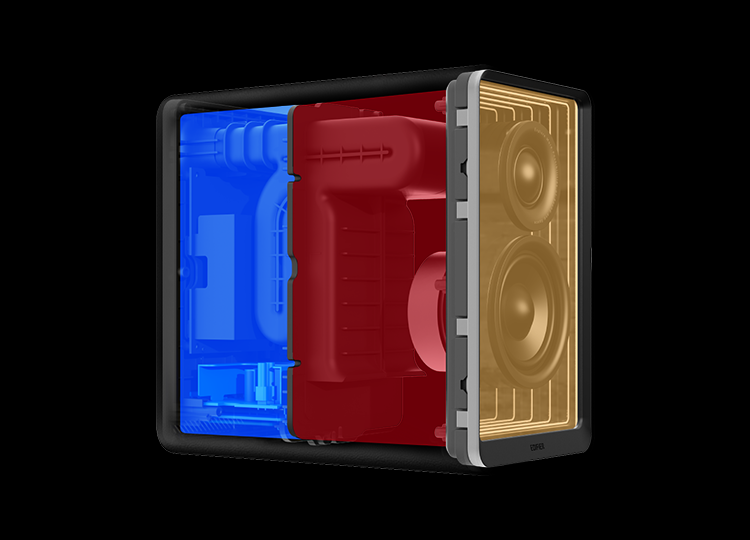
The gateway Edifier. 42W total, 4-inch woofers, wood cabinets. The R1280DBs adds Bluetooth and optical input for about $30 more. These have been Amazon’s best-selling budget bookshelf speakers for years, and the reviews are boringly consistent: good sound for the price, nothing fancy, nothing broken. If you just need speakers that work, this is the floor.
QR65 ($370)
70W RMS, LDAC Bluetooth 5.3, and a built-in 65W GaN charger that replaces your desk charger entirely. This is the one we reviewed at length. The GaN integration is genuinely clever. The missing desktop EQ app is genuinely annoying. At $370 it’s a hard sell on brand perception alone, but the feature set justifies the price if you actually use the charger.
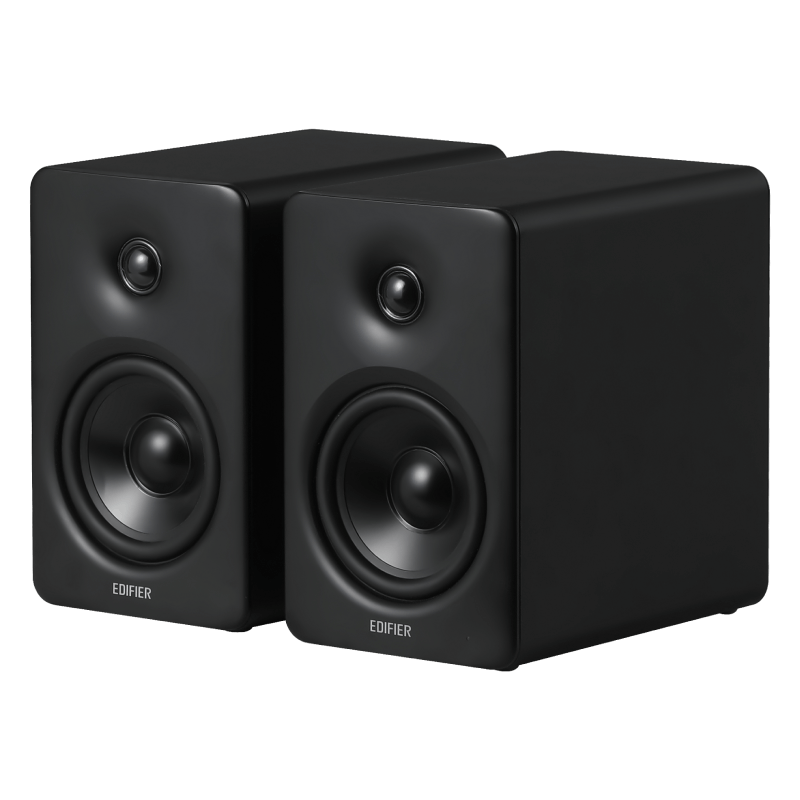
M90 ($370)
100W RMS, HDMI eARC, Bluetooth 6.0. Announced at CES 2026 alongside the XR6 and MR series. The M90 trades the QR65’s GaN charger for HDMI eARC, which means one cable from your TV, console, or dock to your speakers. Same price, different priority. We covered it in our Wire piece.
S2000MKIII ($450)
130W total, tri-amped design, coaxial drivers. This is where Edifier starts competing with proper audiophile desktop monitors. The tri-amped architecture gives each driver its own amplifier, which means less crossover distortion. Bluetooth 5.0 with aptX HD. If you want to hear the STAX influence in Edifier’s speaker tuning, this is where it starts showing up.
S3000MKII ($700)
256W total, planar magnetic tweeter, 6.5-inch aluminum woofer. The flagship. At this price you’re cross-shopping KEF LSX II ($1,200), and honestly the S3000MKII holds up surprisingly well in that comparison. The planar tweeter is genuinely excellent for high-frequency detail. Whether “Edifier” on the grille bothers you at $700 is a personal question, not a sound quality one.
Why Are Edifier Speakers Cheaper Than Western Brands?
One word: vertical integration.
Edifier manufactures their own PCBs, transducers, wood cabinets, and amplifier modules. Most Western audio brands outsource at least two or three of those components. Audioengine sources their drivers externally. KEF doesn’t make their own amplifier boards. Klipsch doesn’t build their own wood enclosures at scale.
Edifier does all of it in their Dongguan factory. When you control every step from raw driver to finished product, your margins look different. That 100,000 square meter facility isn’t just big, it’s vertically complete.
This doesn’t mean Edifier sounds better. It means the price-to-performance ratio is skewed in your favor. A $450 Edifier speaker contains roughly the same bill of materials as a $600-$700 Western competitor. The delta is brand premium, distribution costs, and marketing spend.
How Do Edifier Speakers Compare to Western Audio Brands?
Here’s the pricing reality across four tiers.
| Tier | Edifier | Western Equivalent | Price Difference |
|---|---|---|---|
| Budget | R1280DBs - $160 | Audioengine A2+ - $270 | -41% |
| Mid | M90 - $370 | Audioengine A5+ - $500 | -26% |
| Premium | S2000MKIII - $450 | Klipsch The Fives - $500 | -10% |
| Flagship | S3000MKII - $700 | KEF LSX II - $1,200 | -42% |
The discount narrows at the premium tier. That makes sense. At $450+, you’re paying less for manufacturing cost and more for driver engineering, tuning expertise, and acoustic design. Edifier’s STAX-influenced R&D closes the gap, but brands like KEF and Klipsch have decades more experience in high-end acoustic engineering.
At the budget and mid tier, though? The gap is enormous. The R1280DBs vs A2+ comparison isn’t even close on value. You get 80% of the sound for 60% of the price.
Should You Buy Edifier Speakers?
Yes, if you’re value-conscious. The R1280 line is the easiest recommendation in desktop audio. The QR65 and M90 are legitimate mid-range competitors that add features (GaN charging, HDMI eARC) no Western speaker matches at the price. If your desk setup philosophy is “good enough audio plus fewer cables,” Edifier wins.
Yes, if the STAX story matters to you. This isn’t a company that appeared on AliExpress five years ago. They’ve been building speakers for 30 years, they own one of Japan’s most respected audio brands, and they’re publicly traded with transparent financials. The engineering pipeline from STAX R&D to consumer products like the Spirit S3 is real.
Maybe not, if you’re spending $500+. At the premium end, Edifier competes but doesn’t dominate. The S3000MKII is impressive, but the KEF LSX II has UniQ drivers and a more mature DSP platform. Klipsch has Tractrix horn technology that Edifier can’t replicate. The brand gap is real at this tier, and it’s a gap in acoustic engineering, not just marketing.
Maybe not, if you need desktop software. Edifier’s EQ and control apps are mobile-only. No Windows. No macOS. For a company selling $700 speakers to desk setup enthusiasts, this is a strange omission that doesn’t seem to be changing anytime soon.
The Bottom Line
Edifier is the most interesting company in desktop audio that most Western buyers still underestimate. A $389 million revenue business with 30 years of manufacturing experience and ownership of one of Japan’s most legendary headphone makers, selling speakers that undercut Western competition by 25-40% at most price tiers.
The budget lineup (R1280 series) is an uncontested value champion. The mid-range (QR65, M90) innovates in ways Western brands haven’t attempted. The premium tier (S2000MKIII, S3000MKII) is competitive but faces real engineering competition from established audiophile brands.
If you’ve written Edifier off as “cheap Chinese speakers,” the numbers and the STAX acquisition suggest you should take another look.
Our Edifier coverage: QR65 Review (8.5/10) | QR65 vs Audioengine A2+ | M90 Wire
Related: Best Desktop Speakers 2026 | Chinese Brands Desk Gear Guide
DeskForged covers Chinese brands that western reviewers skip. No sponsorships. We bought our own Edifier gear.